Friday, March 19, 2010

Jonathan Rauch, the Atlantic, and I'm sorry but by mom makes me crazy

Sometimes, before the world wakes up, I try to catch up on my reading--Newsweek, PC World, the Signals catalog, Sunset's "100 Tips for a Great Garden" and, this morning, the Atlantic.

I almost skipped over Jonathan Rauch's "Letting Go of My Father" because I've read it before, a sort of opposite of a coming-of-age story. The deck to the headline contained the usual catch phrases "utterly unprepared for one of life's near certainties--the decline of a parent" and "crisis" and "silently strugging to cope."

Been there, doing that. Just another writer flapping his/her/my jaws (or fingers) about how impossible it is to take care of an elderly parent. Tell me something I don't know.

He did.

He told me I wasn't crazy for thinking there is no safety net, in fact, no net of any kind that's immediately apparent to the parent of a parent; that my feelings of inadequacy are understandable; that there is help but you have to know where to look; and that society treats the information you need to deal with this issue like a great big secret.

"My professional work all but stopped," he writes in the April issue. "Finding doctors for him and getting him to appointments and coordinating escalating medical needs swallowed entire days."

After one medical crisis, he writes, "I stood there with...no idea what to do, frightened by my incompetence and worse, furious at my father for putting me in this impossible situation. That was the day I realized that he could not cope, and I could not cope and, emotionally, he could take me down with him. And I discovered in myself an awful determination not to let that happen."

In his quest to save his father and his own sanity, he discovered this: "Family caregivers face elevated risks to their physical health, mental health, finances employment and retirement," according to the Rosalynn Carter Institute for Caregiving at Georgia Southwestern State University.

His solution, especially to the mental health issue, was to talk, as he calls it, in socially inappropriate settings. "A provocation as simple as 'How are you?' would educe an answer like, 'Bad, I'm at my wits' end coping with my father.' Out would come the whole story."

I blushed because I've done this over and over. At first, I thought this just a manifestation of the compulsive Catholic need to confesss, or, as my cousin Muriel says of our family, "Ask us what time it is and we will tell you how the clock was made." But this is somehow different/

Witness:

Jamie, a colleague at work, who made the mistake of asking me one day what kind of reaction I'd had to a story I wrote. The conversation made a sharp right turn to my mother. (Thank you, Jamie, for not immediately calling the employee assistance program on me.)

Mark, a new acquaintance who kindly invited me out to lunch. (I salute you, Mark, for letting me tell you, over slippery shrimp, about my trifecta of troubles--my failing cat and mother and my husband, who isn't doing so hot either. )

Lili, the hairdresser whose gentle touch somehow unleashes my litany of woes. (Bless you, Lili, for keeping my head and my hair on straight.)

And to so, so many others (including Dee the drycleaner, who gives me a ticket to talk therapy merely by asking, "How's your mom?").

These people differ from my family and friends, who are great listeners all, but they've come to expect to be on the other side of the confessional.

But these other folks, these unwitting victims of my angst ambush, never signed on for this. Please know, wherever you are, that you've probably saved my health.

And I know you've helped mend my heart.


Thursday, February 25, 2010

St. Gen, we hardly knew ye

It’s just a car.

It’s just a 1998 Buick Century with less than 30,000 miles on it, sitting out in the elements, looking sad because it’s not getting enough use.

It’s just a gold 1998 Buick Century with a battered-in door that told me she probably shouldn’t be driving anymore.

It was just her car with the personalized plates that said “St. Gen,” which told us, tongue in cheek, how she viewed herself.

And now it belongs to Max, one of her great grandsons, who has earned the “great” part of that label. He told me in person and later announced on his Facebook page that he’s lucky to have the family he does or he wouldn’t have the wheels. He probably doesn’t realize how lucky we are to have a 16-year-old boy who understands the meaning of family.

“I gave that car to him, didn’t I?” my mom asks, half as a question because she can’t always remember, half as a validation that she did something good.

“Yes, you did,” I say and I smile to let her know she did, in fact, do something good.

“Well, there was no sense in letting it sit there and deteriorate,” she says. “He can make good use of it.”

Indeed he can. At 16, having your own car, even one that’s 12 years old, even a granny car, even one with a sort of bashed in door, means freedom.

At almost 90, not having a car signals just the opposite.

I wept when I pulled in the parking lot this week. Its absence speaks as loudly as its presence.

So long, St. Gen.

Friday, January 15, 2010

Just a couple of boobs out for a good time

It seemed like a good idea at the time, but who knew it would turn into a giggle fest? Mom, who survived breast cancer 23 years ago, and I both needed a mammogram, so why not Breast Fest 2010?

Maybe the weirdness runs in the family. In his first year of college, my nephew, Michael, and a friend dressed up as breasts and went to a Halloween party as a couple of boobs. My mom and I followed in their footsteps.

First, the all important check in. My mom and I have the same last name; she’s Genevieve, and I’m Catharine and not only do we not look one bit alike (she’s blonde and blue eyed), but she’s also 34 years older than I. Since I’m not a spring chicken, that makes her elderly, a word I use with great caution as my own dotage approaches. But let’s face it, friends: If Woodrow Wilson was president when you were born and Warren G. Harding became president before you could crawl, that doesn’t exactly make you Hannah Montana.

Conversely, if Ike was in office when you were born, your name could not be Genevieve Hamm. But it didn’t seem to occur to check-in chick when she asked me, somewhat conspiratorially, how long it had been since my breast cancer. It had, in fact, been a very bad day, but was it so bad that I really looked like someone whose DOB clearly said 1920?

“Bad news,” I told my mom when I returned to her in the waiting room after straightening out the confusion. “They think you’re 55, and frankly, for 55, you don’t look so hot. “

And then we both started to giggle.

I knew what was coming next. It’s an old joke between us. “Did you tell them to charge me half price?” she said. “I only have one, you know.”

More giggling.

We sobered up a bit in the undressing room. We had one wheelchair, two smocks, two purses, and three breasts that needed attention. We pushed and pulled and wiggled and squirmed. I have seen my mom’s mastectomy scar, but it has been only in the last couple of years. She was ashamed, I think. But now it’s just another reminder that she’s one tough broad. So she let me wrestle her out of her top and into her smock. Again, I knew what was coming: “Do you know my Chinese name?” she said “It’s One Hung Low.”

Giggling.

So we were both dressed in pink smocks that opened toward the front and sitting in the waiting room. And sitting and waiting and waiting, watching some DVD that looked like the Cirque du Soleil acroclowns running and jumping and leaping and twirling. It very much approximated what we had just done in the undressing room, except they had on cooler makeup.

And certainly better costumes. Our little pink numbers were a bit drafty. I was fussing with mine and realized that people were looking at me as if to say, ‘”Just because your mother is having a mammogram doesn’t mean you had to get into costume too, you attention whore.” My face flushed, and I wished for a sign that said, “I'm Having One Too.”

Waiting and more waiting. Only a couple of women had been called in the hour we’d been there, and more were arriving. My mother leaned over and said, “It’s like the roach motel. They check in but they don’t check out.”

More giggling.

Finally, they called us. Actually they called her, so this gave a whole new group of people the chance to think of me as an attention ho.

It is not easy, under the best of circumstances, to do the mammo dance. It’s kind of a cross between the Tennessee Waltz and the lambada, and if you’re 89 and you never followed directions well and now you can’t really follow them at all, well, it's more like doing the Monster Mash.

I stood behind her and held her up while they took both sets of pix. I absorbed her radiation and, then, my own. No big deal. She would have done it for me.
And as I stood there, holding this fragile little old lady, I prayed—that we’d both be fine and that, God willing, we’d get to do this again next year, just a couple of boobs, giggling, giggling, all the way.

Sunday, December 27, 2009

A Christmas Gift to Remember

On Christmas Eve, I came over to my mom's place so her caregiver could go home for the night. I wasn't looking forward to it. I had been up since 3 a.m., and I know from experience that I never get much sleep because she gets up frequently.
About 10 p.m., I went in and she was rolled over in her bed with her face against the security rail.
I touched her hand--it was baby soft--and said, "Mom, move back over. Yu're going to fall out."
She woke up briefly and smiled and grabbed my hand. "Am I dreaming this?" she said. I smiled and said no.
"My baby girl," she said. And she went back to sleep.
I dozed until about 3 when I heard her again and went in.
Did she need to get up? No.
Did she need anything? No. No, wait. Yes.
"I need you," she said.
So I said, "Why don't I get in bed with you?" She nodded and so I did. She reached over stroked my hair. "My Christmas bedfellow," she said.
All at once, I was 5 years old again. The stockings were hung on the sofa with care, and I knew in my heart that Christmas was here.

Monday, November 23, 2009

For mercy's sake, will somebody please yell, "Cut!"?

One of the great maxims of life is this: People like people who are like themselves.
I see people like me all the time—in the elevator, in the hallways, in the parking lot.

They are the daughters of the mothers who live in this complex.

They come in all shapes and sizes and colors, but they are just like me. Their faces are a strange mixture of apprehension and fatigue and concern.

And they sound just like me
“Are you warm enough, Mom?”
“Wait, I’ll get the car. I have some junk In the back, though, that I’ll have to clear to get your wheelchair/walker/cane in.”
“Yes, it’s lovely out. Isn’t it? I mean, it’s just beautiful. Good day to go out, don’t you think? I said GOOD DAY TO GO OUT, DON’T YOU THINK?”

We have the same vocabulary. We’re mostly the same age. We drive the same car (mostly Priuses or mid-size SUVs), we have the same cell phones.

So if people like people who are like themselves, why don’t I like them?

Because they remind me too much of what I’ve become. I am the helicopter parent—not hovering over my children, but hovering over my parent and not always as gracious as I should be.

Once, on the long elevator ride downstairs, I said to a daughter, “Is your mom in here? How’s she doing?” (“Yes. OK.”)
“You know,” I said, “we really ought to have some sort of group for us daughters.”
She looked up at me, and her eyes flashed. “Who has time?” she snapped.
I smiled and said, “Good point.”
The woman was rude. I’m a serial overreactor, but for once, I wasn’t offended because I knew it wasn’t really lack of time that ticked her off. And it’s not a matter of who has energy. Or even who has patience.

It’s a matter of who has answers, and the answer to that is that none of us does.
Putting on a brave front has turned us into a bunch of bad actors with bad attitude.
If we had an award for Best Performance by a Daughter Who Doesn't Think Old Age Is a Complete Disaster, I couldn't think of one nominee.

Could you?

Sunday, October 11, 2009

Now who needs the anti-depressant?

This won't be a news flash to anyone who knows the situation, but I am not going to win Daughter of the Year (or wife or employee or friend, but those are separate columns). And I also have to acknowledge that Big Pharma does have something going for it.

About three days before a business trip, I was scrambling to make sure my mom had all her meds and that I had placed them all in the proper containers so her caretakers could dole them out at the appropriate time. Three needed to be refilled, so I called them in and went to pick them up.

The pharmacist, who is sometimes my BFF and sometimes the Spawn of Satan, apparently had chosen Personality No. 2 and would not, not, not refill the Lexapro, an anti-depressant, because it was too early. But, I said, I'll be out of town. Way too early, she said.

So I was two for three. If Manny were that good, we wouldn't have had that cliffhanger vis a vis winning the division. But in the world of elder care, two for three isn't quite good enough. She had enough for five days, and I would be away only for seven.

So I went off and came back. And then I did the bad thing.

I forgot.

I forgot that the one script that remained unfilled was the anti-depressant, and I didn't remember until the first Sunday I spent with her. We could have made a movie called "The Devil Wears Depends" that day.

I quickly had the script refilled and re-started her on it. This Sunday, she is like a different person. She is smiling and laughing, and a moment ago as I was standing near her, she reached out to pat my hand.

She should have slapped my wrist.

Because 88 is no time to lose a day to depression.

Monday, August 24, 2009

The Mom Chronicles: How Can I Be Blue?

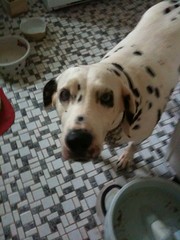
My mom and my dog are best of friends. I think Mom identifies with Blue (at right).

Blue (a.k.a. Puppy Girl) is a rescue Dalmatian who came into our lives about six years ago. She was a quivering mess. Still is, somewhat. We're not sure how old she is, but we believe that she was one of the puppies born shortly after the last "101 Dalmatians" movie, which was 1996. Which means neither she nor my mom is any spring chicken.

From what SavetheDals.org tells me, Blue was used as a puppy mill and when the family moved, she was kicked to the curb. We don't know much more, except that the hair is gone from her joints because she apparently slept from concrete; that she is afraid of brooms and sprayed water, which may have been used as discipline; and that, despite it all, she lives to please. Her tail could challenge any metronome and win.

My mother was furious with me when I showed up at her house with Blue (so named for her blue eyes). "You work too many hours to have a dog!" she barked. (My mom, not Blue.) And in one of the more famous nonsequiturs, I said, "Let's go to the beach." And we did. As we sat on a bench, I told her what I knew about Blue, and her heart melted, as she heard the sad story of puppies taken away and punishment meted out.

Puppy Girl was in. They've been the best of friends ever since.

When my mom still lived in her own home, P.G. would say with her. Nowadays, Blue comes for short visits or my mom comes to the house to see Blue. Absent a personal visit, we have photos of Blue in the apartment and a Dalmatian calendar and a Dalmatian blanket that Mom has dubbed "Puppy Girl."

At 5:45 this morning, my mom is ready to get up. I am not, but it doesn't matter. We get up anyway, and she totters into the TV room. The blanket is ready to assist. Its companion is a blue blanket, which my mother has dubbed "Puppy Girl Part 2."

As I spread them over her legs, I say, "Here comes Puppy Girl!" and then "Here comes Puppy Girl Part 2!" and my mother says, "Oh, Puppy Girl. Oh Puppy Girl Part 2. I need you. I am so cold. You warm me up."

You do too, Mom.